

























Built For IndustriesIndustry-specific delivery experiences that match how your customers buy—whether it’s speed, precision, security, or seamless returns.
FashionCreate a standout customer delivery experience with flexible fulfilment, on-brand tracking, and frictionless returns that keep customers coming back.
LuxuryDeliver a premium experience end-to-end with white-glove options, tighter control, and intelligence that protects brand trust and margin.
3PLWin and retain retail clients with streamlined operations, clear SLA reporting, and scalable workflows that perform under peak pressure.
Health & BeautyDelight beauty shoppers with a polished experience—fast fulfilment, flexible checkout choices, on-brand tracking, and easy returns that build trust.
Home & DIYHandle bulky, fragile, and multi-part shipments with smarter rules, scheduled options, store-as-hub fulfilment, and proactive updates that keep projects on track.
Sports & LeisureDeliver gear on time with flexible options, smart routing for oversized orders, and real-time visibility. Branded tracking cuts WISMO, protects valuables.
AI Powered Capabilities
One Intelligent Layer for Every Delivery Decision
Unify data, insight, and automation across checkout, fulfilment, and post-purchase—so delivery decisions are smarter, faster, and always improving.
Built For TeamsRole-based capabilities for every team in the delivery chain—from IT and Procurement to Customer Service and Finance—with shared data and control.
Ecommerce & DigitalTurn delivery into a growth engine with flexible checkout options, branded tracking, and data-driven carrier control—boosting conversions, retention, and global expansion.
Logistics & TransportHigh-performance logistics platform that automates fulfilment, unifies carriers, cuts shipping and customs costs, boosts visibility, and reduces risk end-to-end.
ProcurementStrengthen procurement with rapid carrier onboarding, real SLA intelligence, and diversified sourcing—cut costs, reduce risk, and negotiate better with trusted data.
Customer ServiceProactive, data-rich delivery support that reduces “where is my order” inquiries, predicts issues early, speeds resolution, and keeps customers loyal post-purchase.
IT & EngineeringAPI-first delivery infrastructure with modular components, enterprise security, sub-300ms performance, and fast carrier onboarding to scale without technical debt.
FinanceUnified, parcel-level shipping cost visibility and controls that improve forecasting, allocate spend accurately, prevent overspend, and protect margins.
AI Powered Capabilities
One Intelligent Layer for Every Delivery Decision
Unify data, insight, and automation across checkout, fulfilment, and post-purchase—so delivery decisions are smarter, faster, and always improving.
Checkout & ShippingIndustry-specific delivery experiences that match how your customers buy—whether it’s speed, precision, security, or seamless returns.
Delivery OptionsShow real-time, validated delivery choices at checkout—fast to deploy—boosting conversion, confidence, and repeat purchases with flexible pickup and fulfillment options.
Delivery ManagerUnify global carriers, automate fulfilment, cut shipping costs, scale fast, and deliver flexible checkout options with a high-performance API.
AI Powered Capabilities
One Intelligent Layer for Every Delivery Decision
Unify data, insight, and automation across checkout, fulfilment, and post-purchase—so delivery decisions are smarter, faster, and always improving.
3 Reasons Carrier Flexibility is the New Competitive Edge
If the past few years have taught us anything, it’s that shipping challenges are inevitable and often feel endless. From peak season volume surges and carrier capacity crunches to geopolitical issues and rate volatility, shipping failures and disruptions are, unfortunately, consistent features of the delivery process.
3 Reasons Carrier Flexibility is the New Competitive Edge
If the past few years have taught us anything, it’s that shipping challenges are inevitable and often feel endless. From peak season volume surges and carrier capacity crunches to geopolitical issues and rate volatility, shipping failures and disruptions are, unfortunately, consistent features of the delivery process.
With a broad portfolio of personal care, beauty, and wellness products, the Nu Skin website showcases a wide range of science-backed solutions available to customers worldwide.
Why Business Automation Isn’t Optional in 2026Automation is the 2026 competitive edge—eliminate manual time-drains with faster fulfilment, fewer errors, and smarter delivery operations at scale.
The companies that will thrive in 2026 have one thing in common: they're automating the time-drains holding others back. Business automation uses technology to handle repetitive tasks automatically—without human intervention—so your team can focus on higher-value work.
Resource HubLearn more about Metapack, watch webinars on demand, download whitepapers, access the Developer Centre, and more.
EventsView upcoming and past Metapack events—from TDC to curated industry meetups and sessions.
GuidesExplore strategic guides from benchmark reports and whitepapers to ebooks.
Help CentreGet product help, documentation, and release notes across Metapack solutions.
Developer CentreExplore API docs, integration guides, and developer tools for Metapack delivery services.
REPORT
Metapack Ecommerce Benchmark Report 2026
Ecommerce has reached a decisive turning point. For years, the industry focused on optimizing for human behaviour—better websites, faster checkout flows, smarter pricing, and more flexible delivery options. In 2026, ecommerce is entering a new phase where retailers are no longer competing only for human attention.
Since the early days of the internet, ecommerce has directly competed with physical stores for consumer spending. For many, the 2020 pandemic and resulting boom in online sales marked the end of in-person shopping for good, but the truth is a little more nuanced.
To paint a clearer picture of the future of ecommerce, we surveyed over 8,000 consumers and 400 retail business executives. We compiled our findings into the Ecommerce Delivery Benchmark Report 2025, outlining how businesses adapt to new realities and the effects of new technologies, like AI, on growth strategies.
Here’s what we found.
An Upcoming Inflection Point
After years of rapid growth in North America and Europe, the ecommerce market has matured, reaching a peak. Of the businesses we surveyed, 84% reported growth in 2024, but only an average of 5.6% industry-wide, a far cry compared to a few years ago.
A Post-COVID Commerce Market
Consumer data further justifies the poor performance, as more than half of individuals surveyed said they plan on shopping more in-store in 2025. More than bargains or convenience, younger generations (primarily Gen Z and millennials) prioritise immersive and satisfactory shopping experiences, whether online or offline.
Rather than wage a battle between in-person and online shopping, the future of commerce is in prioritising omnichannel marketing. It’s time to master the complexity of integrating the digital with the physical instead of choosing one over the other, especially if you can’t fight against the low prices of online retail giants like Temu or Shein.
Solving the Delivery Problem
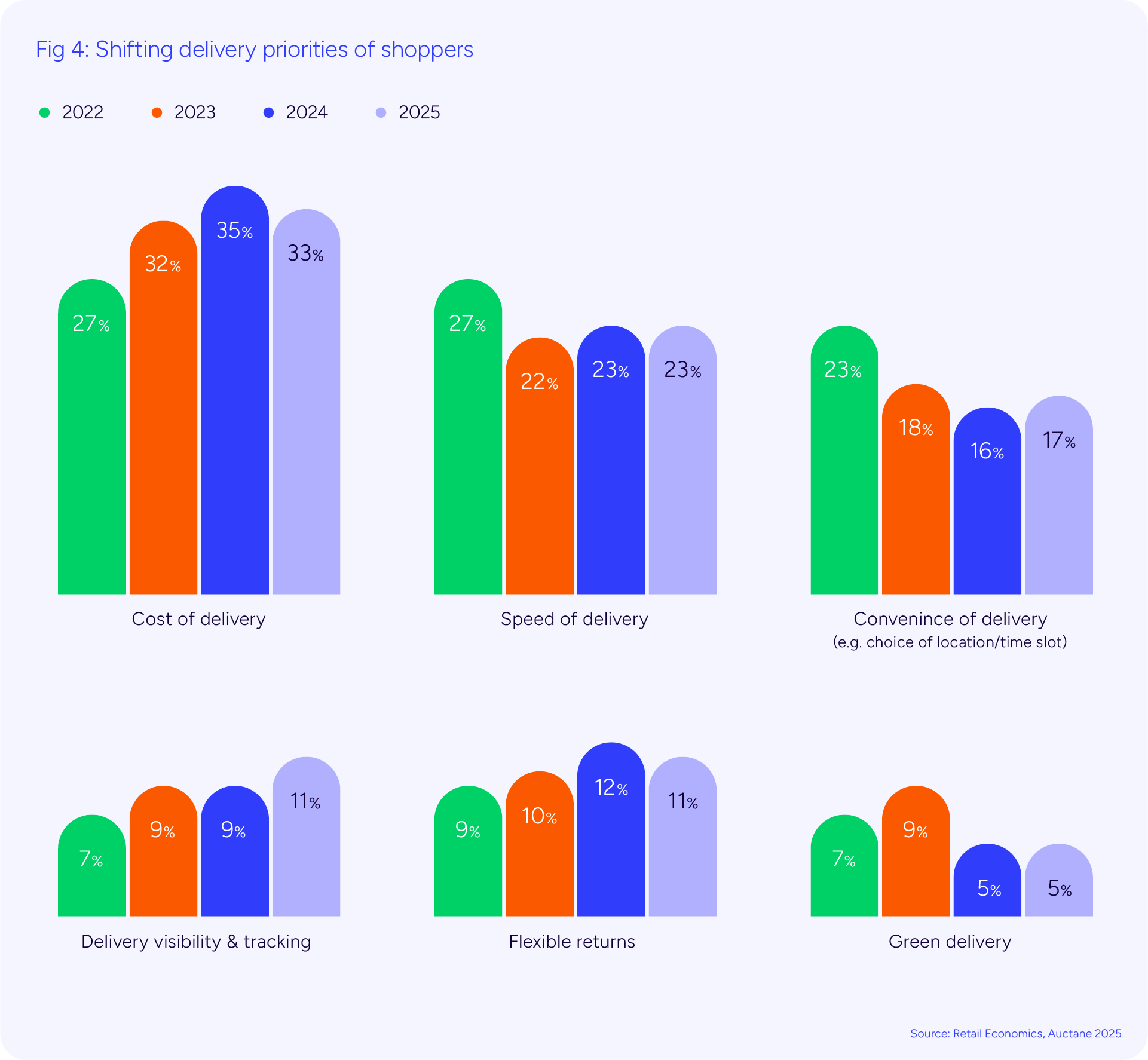
The time between a customer placing an order and receiving their package has the potential to either make or break a loyal customer. While customers overwhelmingly prioritise affordable delivery and speed, you can’t neglect factors such as convenience and trackability.
What’s Driving Ecommerce Growth in 2025?
It’s no secret that ecommerce first took off thanks to the widespread adoption of the internet, and then once again with smartphones and social media. Nowadays, retailers need to track generative AI and growing overseas markets carefully.
Making the Most of Tech
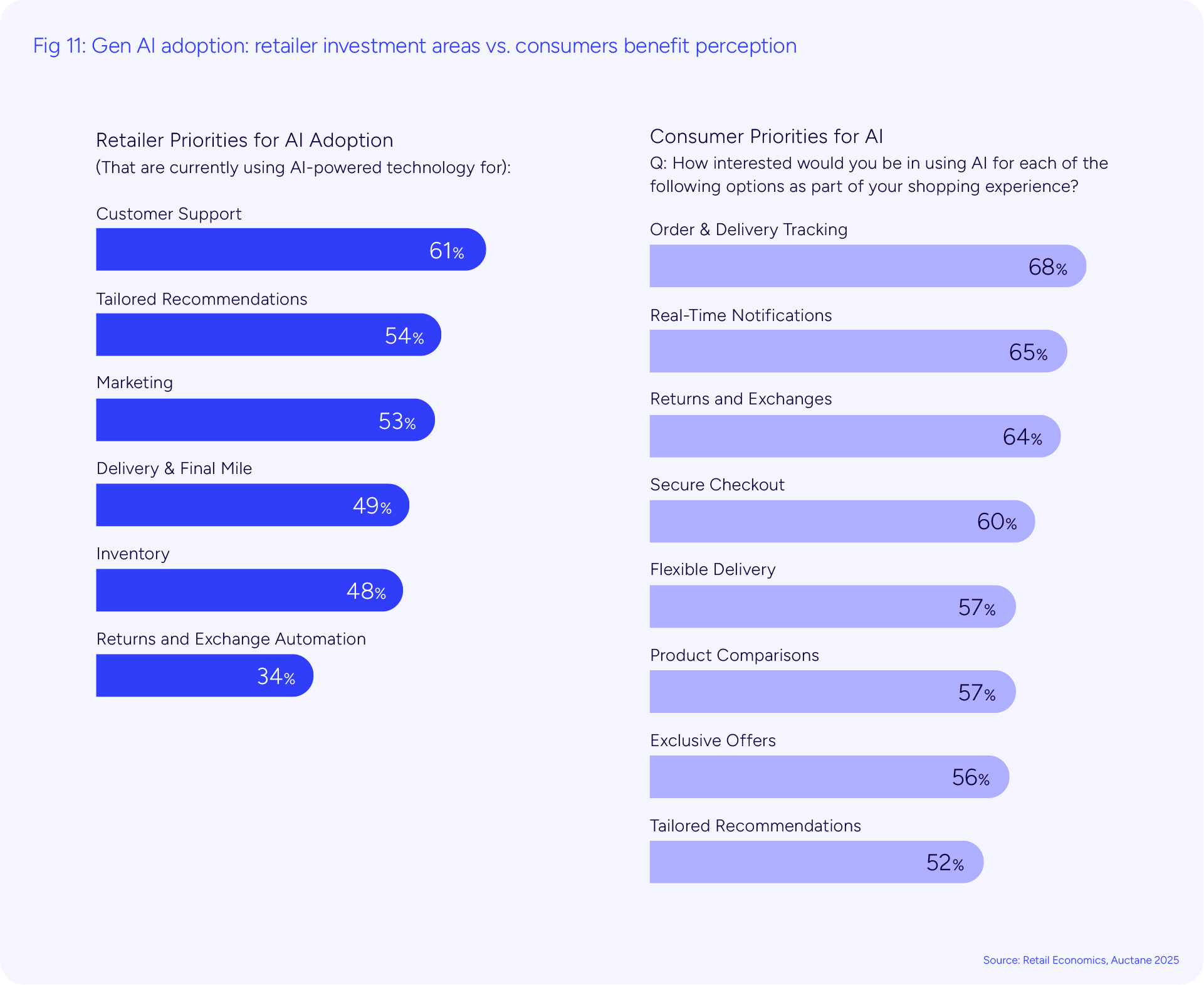
Customers view AI differently from executives and administrators. They generally prioritise technology that tracks their orders and provides real-time, custom notifications. Meanwhile, retailers are focusing AI more on automated chatbots and smart FAQ pages. Our 2025 Benchmark report found that consumers are most interested in using AI for order and delivery tracking, while retailers currently prioritise this technology for customer support.
Gen Z and Millennials Hold the Shopping Control
Another critical growth aspect is generational interests. Millennials and Gen Z make up over 70% of all online shoppers, with more than half preferring content-based marketplaces over traditional ecommerce sites.
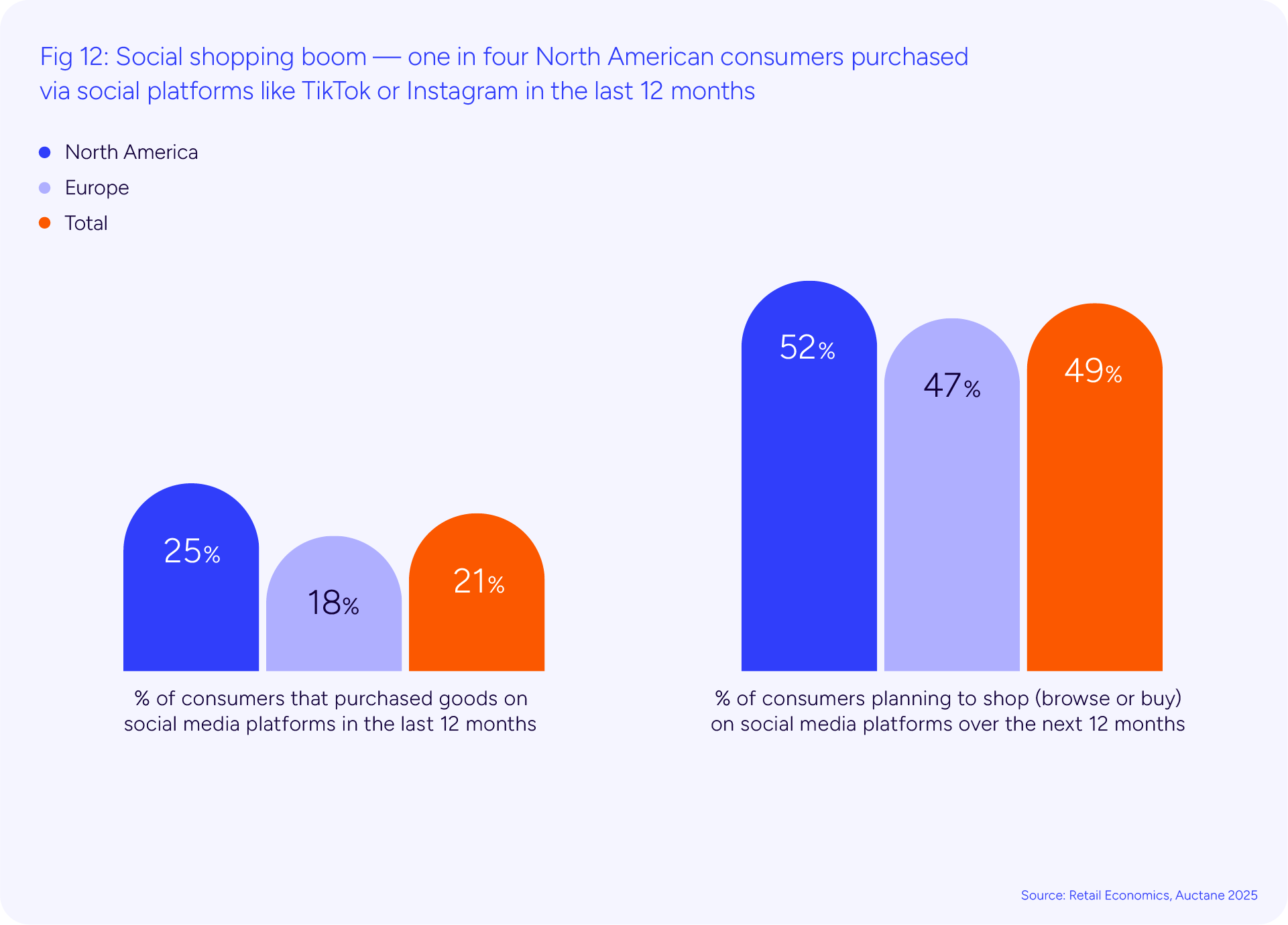
TikTok and Instagram have seen massive success in combining leisure web browsing with ecommerce. In North America, one in four consumers has purchased something off a social media market in the past 12 months.
Learning From Early Adopters
Another way retailers are bridging the gap between in-person and online shopping is through click-and-collect and in-store returns of items purchased online. Previously strictly brick-and-mortar stores like Walmart, Next, and Kingfisher (B&Q) were some of the first to successfully transition to this hybrid model.
Taping Into International Markets
The future of retail growth lies in international markets. Social media brings local eyes to your marketplace, but overseas interest, mainly in Southeast Asia, the Middle East, and Latin America, can help it take off. The trick is to start small, building relationships with international logistics and shipping companies, then scale fast, riding on the momentum of novelty and trends.
International expansion is looking particularly bright for apparel, luxury, and tech retailers. Consumers are willing to pay more for the quality and convenience of a product, leaving value-focused retailers to struggle.
Strategise or Miss Your Shot!
With a maturing market, rising operational costs, and heightened consumer expectations, it’s more important than ever to have a fool-proof strategy for growth moving forward. The path ahead will be paved with innovation and creativity, traits appreciated more by the younger generations compared to their older counterparts.
In our 2025 Benchmark Report, we gathered 10 actionable strategies to help you make the most of the 2025 ecommerce market:
Take a unified approach to delivery and logistics
Tailor the shopping experience to every individual consumer
Global expansion is key for sustained growth
Third-party service providers, vendors, and marketplace operators are your friends
Focus on micro-fulfillment through omnichannel optimisation
Plan for product returns and exchanges
Make the most out of predictive analytics, AI, and inventory management
Integrate with existing online marketplaces
Merge discovery with sales through social commerce
Foster customer loyalty with post-purchase engagement
Take full advantage of the upcoming retail revolution by being open to transforming and adapting to new environments. Explore our data-driven insights by reading the full Ecommerce Delivery Benchmark Report 2025.
When you’re ready, book a free demo with our delivery software experts to make your next move.