























Built For IndustriesIndustry-specific delivery experiences that match how your customers buy—whether it’s speed, precision, security, or seamless returns.
FashionCreate a standout customer delivery experience with flexible fulfilment, on-brand tracking, and frictionless returns that keep customers coming back.
LuxuryDeliver a premium experience end-to-end with white-glove options, tighter control, and intelligence that protects brand trust and margin.
3PLWin and retain retail clients with streamlined operations, clear SLA reporting, and scalable workflows that perform under peak pressure.
Health & BeautyDelight beauty shoppers with a polished experience—fast fulfilment, flexible checkout choices, on-brand tracking, and easy returns that build trust.
Home & DIYHandle bulky, fragile, and multi-part shipments with smarter rules, scheduled options, store-as-hub fulfilment, and proactive updates that keep projects on track.
Sports & LeisureDeliver gear on time with flexible options, smart routing for oversized orders, and real-time visibility. Branded tracking cuts WISMO, protects valuables.
AI Powered Capabilities
One Intelligent Layer for Every Delivery Decision
Unify data, insight, and automation across checkout, fulfilment, and post-purchase—so delivery decisions are smarter, faster, and always improving.
Built For TeamsRole-based capabilities for every team in the delivery chain—from IT and Procurement to Customer Service and Finance—with shared data and control.
Ecommerce & DigitalTurn delivery into a growth engine with flexible checkout options, branded tracking, and data-driven carrier control—boosting conversions, retention, and global expansion.
Logistics & TransportHigh-performance logistics platform that automates fulfilment, unifies carriers, cuts shipping and customs costs, boosts visibility, and reduces risk end-to-end.
ProcurementStrengthen procurement with rapid carrier onboarding, real SLA intelligence, and diversified sourcing—cut costs, reduce risk, and negotiate better with trusted data.
Customer ServiceProactive, data-rich delivery support that reduces “where is my order” inquiries, predicts issues early, speeds resolution, and keeps customers loyal post-purchase.
IT & EngineeringAPI-first delivery infrastructure with modular components, enterprise security, sub-300ms performance, and fast carrier onboarding to scale without technical debt.
FinanceUnified, parcel-level shipping cost visibility and controls that improve forecasting, allocate spend accurately, prevent overspend, and protect margins.
AI Powered Capabilities
One Intelligent Layer for Every Delivery Decision
Unify data, insight, and automation across checkout, fulfilment, and post-purchase—so delivery decisions are smarter, faster, and always improving.
Checkout & ShippingIndustry-specific delivery experiences that match how your customers buy—whether it’s speed, precision, security, or seamless returns.
Delivery OptionsShow real-time, validated delivery choices at checkout—fast to deploy—boosting conversion, confidence, and repeat purchases with flexible pickup and fulfillment options.
Delivery ManagerUnify global carriers, automate fulfilment, cut shipping costs, scale fast, and deliver flexible checkout options with a high-performance API.
AI Powered Capabilities
One Intelligent Layer for Every Delivery Decision
Unify data, insight, and automation across checkout, fulfilment, and post-purchase—so delivery decisions are smarter, faster, and always improving.
3 Reasons Carrier Flexibility is the New Competitive Edge
If the past few years have taught us anything, it’s that shipping challenges are inevitable and often feel endless. From peak season volume surges and carrier capacity crunches to geopolitical issues and rate volatility, shipping failures and disruptions are, unfortunately, consistent features of the delivery process.
3 Reasons Carrier Flexibility is the New Competitive Edge
If the past few years have taught us anything, it’s that shipping challenges are inevitable and often feel endless. From peak season volume surges and carrier capacity crunches to geopolitical issues and rate volatility, shipping failures and disruptions are, unfortunately, consistent features of the delivery process.
With a broad portfolio of personal care, beauty, and wellness products, the Nu Skin website showcases a wide range of science-backed solutions available to customers worldwide.
Why Business Automation Isn’t Optional in 2026Automation is the 2026 competitive edge—eliminate manual time-drains with faster fulfilment, fewer errors, and smarter delivery operations at scale.
The companies that will thrive in 2026 have one thing in common: they're automating the time-drains holding others back. Business automation uses technology to handle repetitive tasks automatically—without human intervention—so your team can focus on higher-value work.
Resource HubLearn more about Metapack, watch webinars on demand, download whitepapers, access the Developer Centre, and more.
EventsView upcoming and past Metapack events—from TDC to curated industry meetups and sessions.
GuidesExplore strategic guides from benchmark reports and whitepapers to ebooks.
Help CentreGet product help, documentation, and release notes across Metapack solutions.
Developer CentreExplore API docs, integration guides, and developer tools for Metapack delivery services.
REPORT
Metapack Ecommerce Benchmark Report 2026
Ecommerce has reached a decisive turning point. For years, the industry focused on optimizing for human behaviour—better websites, faster checkout flows, smarter pricing, and more flexible delivery options. In 2026, ecommerce is entering a new phase where retailers are no longer competing only for human attention.
Everyone’s been keeping a close eye on the ecommerce explosion brought about by COVID-19. One part of the story that hasn’t got a lot of attention is the impact it's had on ‘out of home’ delivery.
Everyone’s been keeping a close eye on the ecommerce explosion brought about by COVID-19. One part of the story that hasn’t got a lot of attention is the impact it’s had on ‘out of home’ delivery. In fact, methods like lockers, PUDOs and in-store pickup have followed an interesting trajectory over the past year. And, if you ask us, things are only going to get more interesting as the world emerges from lockdown. We’re predicting ‘out of home’ is the delivery method to watch in the future. Here’s why.
Decline of out of home delivery during COVID-19… sort of
At first glance, the data suggests that out of home delivery fell during lockdown. It makes sense – during this time we were stuck at home, and accepting online deliveries was one of the few things we were actually able to do. While many ‘out of home’ collection points like PUDOs were deemed essential retail and allowed to stay open, there was also a conscious effort from consumers to reduce trips to stores where possible. In other words, home delivery made sense.
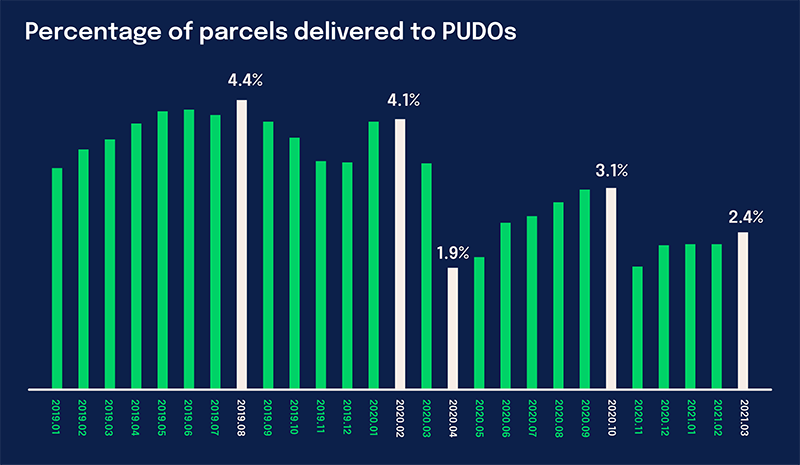
And yet, other forms of ‘out of home’ collection – like lockers – actually grew. For example, one carrier partner Metapack works with recently experienced a 2% rise in the use of their lockers. They attribute this to the fact that many of their lockers are located outside, which made them safer to use during the pandemic. Also, many are situated at supermarkets or petrol stations, which remained open and well-frequented during lockdowns.
The same nuances are true for formats like ‘click and collect’. While in general this method declined, as retail stores were forced to close, in-store pickup in essential retail locations remained relatively stable. For example, one Metapack customer maintained near-2019 usage of ‘click and collect’ in grocery stores throughout 2020.
Delivery expands outside the home
It will come as no surprise that home delivery has remained the most popular mode of delivery during lockdown. In the UK between March to June 2020, we saw a 60% increase in home deliveries. And there were some unexpected upshots, too. For example, our data shows that missed deliveries in the UK have dramatically declined as more people have been at home to accept their orders. Between January 2020 and May 2021, missed deliveries dropped 43%.
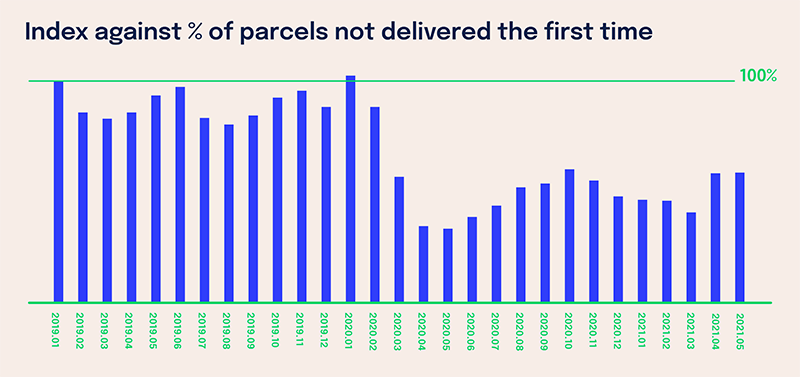
The trajectory of home delivery during lockdown is interesting, but it’s what happens afterwards that matters most. As the world inches closer to a post-COVID reality, many consumers are resuming their old habits: going back to the office, taking the kids to school, meeting friends for lunch. This means more time away from home, and a greater likelihood of missed home deliveries.
Most of the ecommerce growth experienced during the pandemic is likely to stay. In our Ecommerce Delivery Benchmark Report, 42% of consumers said that even after COVID-19 they will continue shopping more online. But as life goes back to normal, consumers will be drawn to delivery methods that complement their life outside the home. For example, customers who get their orders delivered to lockers don’t need to worry about missing their delivery when they get called into the office. They can just stop by the locker box at the supermarket on their way home.
As consumers solidify their online shopping habits, they will soon become aware of “hacks” such as these, and delivery methods like lockers, PUDOs and in-store pickup will start to gain ground on more traditional methods like home delivery.
An appetite for sustainable delivery
Another reason why we’re predicting a rise in ‘out of home’ is because it’s more sustainable. As ‘out of home’ delivery presents an opportunity to bundle multiple orders, the last mile of delivery can be significantly reduced – as can its CO2 footprint.
And reducing the environmental impact of online shopping is increasingly important for consumers. It used to be that cost and speed were the primary factors when weighing up delivery options – and rest assured these are still the main drivers – but sustainability is starting to give them a run for their money. According to the same report, 32% of consumers value sustainable delivery more than cost and speed. A further 47% is willing to wait longer for sustainable delivery. Promoting ‘out of home’ delivery as a sustainable option is an underutilized opportunity.
‘Out of home’ delivery has for a long time played second fiddle to traditional delivery methods like home delivery. However, as a savvier generation of online shoppers emerges from lockdown, we’re betting things will change. If you ask us, ‘out of home’ delivery will be the method to watch in 2021 and beyond.