


























 Customer experience


Ecommerce has reached a decisive turning point. For years, the industry focused on optimising for human behaviour—better websites, faster checkout flows, smarter pricing, and more flexible delivery options. In 2026, ecommerce is entering a new phase where retailers are no longer competing only for human attention.
Artificial intelligence is now impacting how products are discovered, compared, and shortlisted. Machines and algorithms sit between consumers and brands, increasingly shaping decisions—often before a customer ever reaches a brand’s website. As a result, the rules of ecommerce competition are shifting fast.
Metapack’s new Ecommerce Delivery Benchmark Report 2026 explores this shift, drawing on insights from 8,000 consumers across eight major markets and 400 senior ecommerce decision-makers. The findings point to a clear conclusion: AI is already influencing demand, competition, and delivery performance in measurable ways—and retailers that fail to adapt risk becoming invisible in AI-mediated shopper journeys.
Here’s just a glimpse of the important themes from the research, highlighting what’s changing and why it matters. Download the full report to unlock all the key insights, dive deeper into the data, and see how retailers can remain visible, trusted, and easy to transact with in the age of AI-assisted ecommerce.
Retailers enter 2026 with cautious optimism. Many expect ecommerce growth to continue, and a majority anticipate stronger online sales in the year ahead. Yet growth is becoming harder to earn.
Competition is intense, fulfilment and delivery costs remain elevated, and customer acquisition is more expensive. At the same time, the report shows that consumer expectations for speed, convenience, and reliability remain high.
Against this backdrop, AI stands out as the most significant force shaping future performance. When retailers were asked which factors would most affect their business in 2026, adopting AI and emerging technologies ranked above rising costs, tougher competition, and all other factors.
Retailers recognise that AI is changing how demand is created and how decisions are made. The challenge is no longer whether to engage with AI, but how to maximize value.
The data reveals that AI has moved rapidly from experimentation to routine use. Nearly eight in ten consumers have used a generative AI assistant in the past year.
What makes this shift important is how easily it has happened. AI tools are simple to use, embedded in platforms people already trust, and perceived as helpful rather than disruptive.
For ecommerce, this means consumers increasingly rely on AI for tasks that once required multiple websites—checking availability, comparing options, or understanding delivery and returns. Decision-making is becoming more condensed and conversational.
One of the clearest signals in the research is the rise of AI-mediated shopping journeys.
More than one in four consumers have already used chat-based AI tools for shopping-related tasks.
Traffic patterns reinforce this shift. AI platforms already generate retail-intent traffic volumes comparable to some of the largest ecommerce websites. In effect, AI is becoming a new front door to retail.
This has structural implications. Discovery is moving upstream, away from retailer-owned channels. Choices are increasingly narrowed before a shopper ever lands on a product page.
The report draws a clear distinction between AI-assisted commerce and agentic commerce.
AI-assisted commerce supports shoppers by helping them discover products, compare options, and shortlist choices, while leaving final decision-making to humans. This is where most use cases sit today.
Agentic commerce goes further. Here, AI agents act on behalf of consumers—selecting products and completing purchases based on predefined preferences and approvals.
In 2026, the market is entering a semi-autonomous stage. Consumers are becoming more confident in delegating specific tasks, particularly repetitive or low-risk ones. But despite rapid adoption, trust in AI remains conditional. Consumers remain cautious about giving up full control.
Six in ten consumers say they are comfortable using AI assistants during the ecommerce journey, but most prefer defined boundaries. AI narrows the options, but the final decision remains with the shopper.
Smaller groups are open to AI completing purchases with approval or managing repeat orders, but comfort varies by market and category. Different shoppers value different experiences.
As AI shapes discovery and evaluation, delivery becomes more visible and influential.
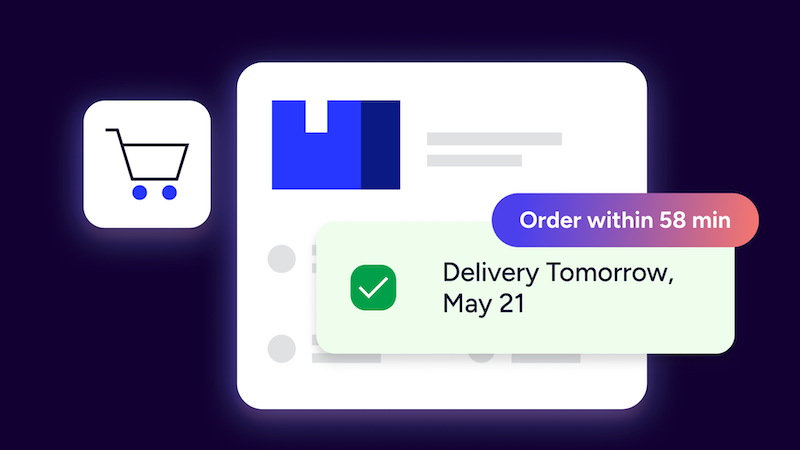
In AI-mediated journeys, delivery is easier to compare and now sits alongside product and price as a key component of perceived value.
The research reveals that while consumers are more cost-conscious, service expectations remain high. Fast delivery is increasingly viewed as a baseline requirement. In many markets, over half of consumers expect standard orders to arrive within two days.
Demand for delivery flexibility is also rising, particularly among younger shoppers. Yet delivery capability has not kept pace, leaving a persistent gap between expectations and reality.
Consumers remain willing to pay for faster or more convenient delivery, but only within clear limits. Using price sensitivity analysis, the research identifies a consistent optimal price range for premium delivery. Below this range, prices can undermine confidence. Above it, resistance rises sharply.
When retailer pricing is compared against these thresholds, a clear execution gap emerges. In many markets, fewer than half of retailers offer premium delivery at an optimal price. Some suppress demand by charging too much. Others erode margin by charging too little.
AI offers a way forward. Delivery is no longer a static fee at checkout. In AI-assisted journeys, it’s a signal that can determine whether a retailer is considered at all.
As agentic systems advance, delivery performance increasingly influences how algorithms assess retailers.
Reliable promises, clear options, and aligned pricing reinforce trust. Inconsistent delivery propositions do the opposite.
Intelligent delivery is emerging as one of the strongest sources of differentiation in an environment where product and price are easier to compare. Retailers that continue treating fulfilment as just a back-end function will struggle to keep up with competitors.
According to the research, most ecommerce businesses expect to increase investment in AI agents and assistants over the next two years. How they approach this varies.
Larger retailers are more likely to build capabilities in-house, navigating integration with legacy systems and governance requirements. Smaller retailers tend to rely on partnerships and platforms to extend their capabilities without overreaching.
In both cases, readiness—not ambition—is the constraint. Data quality, system integration, and real-time decision-making are foundational to success.
Notably, retailers and consumers are broadly aligned on near-term expectations. Both see AI as a helpful assistant rather than a fully autonomous decision-maker. Full delegation remains a minority view, at least for now.
This article simply outlines how ecommerce is evolving in the age of AI. The Ecommerce Delivery Benchmark Report 2026 provides the depth.
Download the full report for detailed market and category comparisons, delivery benchmarks, shopper segmentation, and the complete list of insights to understand where your business stands, what to prioritise next, and how to execute.